
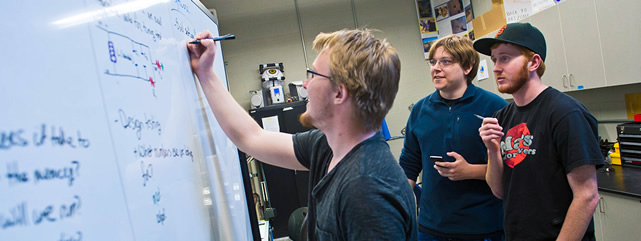
Design the Future
The Prescott Department of Computer, Electrical and Software Engineering empowers students to design the systems and technologies that shape our world. With a hands-on, project-based approach and direct industry alignment, our programs prepare graduates to lead in aerospace, defense, robotics, software and more.
Degrees That Drive Discovery
Students choose from three ABET-accredited programs in Computer Engineering (B.S.), Electrical Engineering (B.S.) or Software Engineering (B.S.). Computer engineering is offered in standard and Robotics tracks, where students explore everything from circuits to code, mastering hardware/software integration, embedded systems and robotics. Electrical Engineering is offered in standard and Robotics tracks, where students gain a strong systems foundation in electronics, communications, controls, Robotics and avionics for careers in aerospace and high-tech industries. Software Engineering is offered in standard and Cyber-security tracks, where students learn to build powerful, reliable software through real-world projects in autonomous flight, hybrid vehicles and cybersecurity.
Real-World Experience, Real Impact
Every degree blends theory with immersive lab work and collaborative design experiences. Students graduate ready to innovate, lead and solve complex engineering challenges on a global scale.
Visit the website of the Department of Computer, Electrical & Software Engineering
Submissions from 2026
External validation of a knowledge-based clinical toxicology consultant for diagnosing single exposures, Hugo Lerogeron, Joel D. Schipper, Jay L. Schauben, Laurent Guéguen, Valentine Lacotte, and Kim An Nguyen
Submissions from 2017
Image and Information Fusion Experiments with a Software-Defined Multi-Spectral Imaging System for Aviation and Marine Sensor Networks, Sam B. Siewert, Matthew Demi Vis, Ryan Claus, Ramnarayan Krishnamurthy, Surjith B. Singh, Akshay K. Singh, and Shivasankar Gunasekaran
Submissions from 2016
Software Defined Multi-Spectral Imaging for Arctic Sensor Networks, Sam B. Siewert, Matthew Demi Vis, Ryan Claus, Vivek Angoth, Karthikeyan Mani, Kenrick Mock, Surjith B. Singh, Saurav Srivistava, and Chris Wagner
