
Singapore / Asia Campus
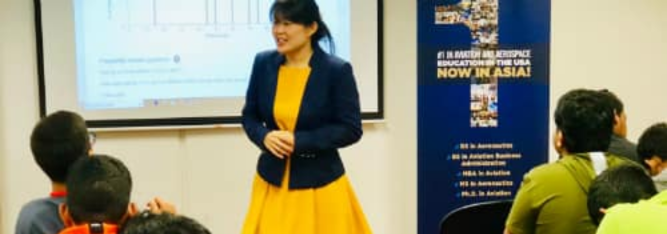
The Embry‑Riddle Asia Campus in Singapore provides solutions to the region’s growing workforce needs.
Through flexible learning platforms and partnerships, such as the collaboration with Singapore Aviation Academy, Embry‑Riddle Asia delivers blended undergraduate and graduate programs specifically for driven students and working professionals.
Undergraduate and graduate degrees at Embry‑Riddle Asia will prepare you to respond effectively to the challenges facing Asia’s growing aviation industry.
In addition to being a global aviation hub, Singapore is one of the world’s most cosmopolitan cities, with a fascinating blend of cultures and lifestyles creating an unparalleled quality of life.
Visit the Singapore / Asia Campus website.
Submissions from 2020
Managing Safety Risks in Airline Maintenance Outsourcing, Rajee Olaganathan Dr., Mark Miller Dr., and Bettina M. Mrusek Dr.
Submissions from 2019
Biotechnological Application in Aquaculture and its Sustainability Constraints, Olaganathan Rajee and Tang Kar Mun Alicia
Submissions from 2018
Algal Biofuel: The Future of Green Jet Fuel in Air Transportation, Rajee Olaganathan
Research of Sustainable Jet Fuel Production Using Microbes, Rajee Olaganathan
Safety Analysis of Automatic Dependent Surveillance – Broadcast (ADS-B) System, Rajee Olaganathan
Submissions from 2017
Modelling Fatigue for Management Decision Making: A Case Study, Rajee Olaganathan, Timothy B. Holt, and Jacqueline Luedtke
Assessing the Efficiency of Different Sustainable Farming Practices in Reducing the Environmental Impacts Caused by Aquaculture, Rajee Olaganathan and Alicia Tang Kar Mun
Impact of Aquaculture on the Livelihoods and Food Security of Rural Communities, Rajee Olaganathan and Alicia Tang Kar Mun
Technological Modernization and Its Impact on Agriculture, Fisheries and Fossil Fuel Utilization in the Asia Pacific Countries with Emphasis on Sustainability Perspective, Rajee Olaganathan and Kathleen Quigley
Submissions from 2015
Is Nutritional Labeling a Sustainable Option for Restaurants?, Rajee Olaganathan, Zack Ho Xuan Yi, Alvin Tan Jie Chong, Wong Xue Feng, Soh Mei Yi, and Felicia Tan Pei Zhen
Submissions from 2014
Applications of Satellite Remote Sensing in the Environment, Rajee Olaganathan, Muhammad Ihsan Bin Ibrahim, Huang Meitong, Tan Yong Jie Shawn, Wilson Tok Wei Sheng, and et al.
Potential and Technological Advancement of Biofuels, Rajee Olaganathan, Fabian Ko Qui Shen, and Lim Jun Shen
Is Biofuel a Feasible Long-Term Chief Energy Source? A Global Perspective, Rajee Olaganathan, Aston Lee, Debra Tong, Mameegate Zheng Jun Cheston, and Zack Ho Xuan Yi
Submissions from 2013
Biofuel from Microalgae – A Review on the Current Status and Future Trends, Rajee Olaganathan, May Zaw Htet, Lim Yan Ling, and Sek Hui Yun
Effect of Anthraquinone Dyes on the Carbohydrate, Protein and Lipid Content in the Muscle of Channa Punctatus and Cyprinus Carpio, Rajee Olaganathan and Jamila Patterson
Submissions from 2012
Biodegradation of Textile Dye Anthraquinone Vat Blue 4 by Pseudomonas Aeruginosa, Rajee Olaganathan and Jamila Patterson
Histological Changes in the Target Organs of Channa Punctatus after Exposure to Anthraquinone Vat Dyes, Rajee Olaganathan and Jamila Patterson
Submissions from 2011
Decolorization of Azo Dye (Orange MR) by an Autochthonous Bacterium, Micrococcus sp. DBS 2, Rajee Olaganathan and Jamila Patterson
Submissions from 2009
Decolorization of Anthraquinone Vat Blue 4 by the Free Cells of an Autochthonous Bacterium, Bacillus Subtilis, Rajee Olaganathan and Jamila Patterson
